Low-E: Spectral Selectivity and Infrared Reflection
Low-emissivity (Low-E) glass constitutes the single greatest technological leap in building energy conservation of the past half-century. It functions as an optical valve, permitting short-wave visible light while barricading invisible long-wave heat.
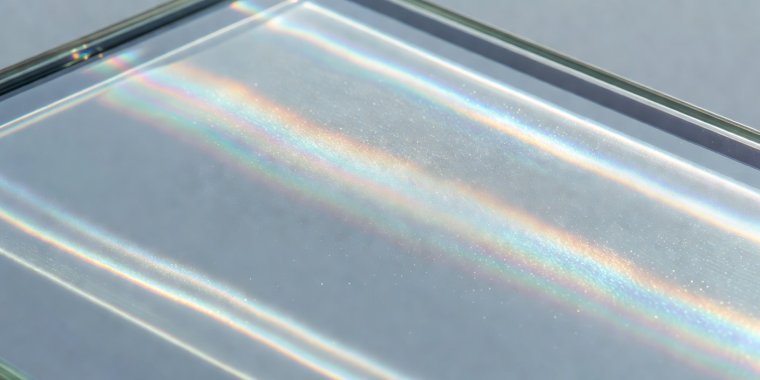
The Electromagnetic Spectrum and Fenestration
Solar radiation arrives at the building envelope in three distinct bands: ultraviolet (UV, 300–380 nm), visible light (380–780 nm), and near-infrared (NIR, 780–2500 nm). Once that light passes into an interior and strikes surfaces, rugs, and furniture, those objects absorb the energy and re-radiate it as far-infrared heat (wavelengths above 2500 nm).
Untreated standard float glass is opaque to UV and partially transparent to visible and near-infrared, but it absorbs far-infrared and re-radiates it outward into the night sky. Low-E coatings selectively alter this behavior. By deploying microscopically thin metallic and metal-oxide strata, fenestration engineers create destructive optical interference that selectively reflects thermal radiation.
Hard Coat (Pyrolytic) vs Soft Coat (Sputtered MSVD)
Modern architectural glass relies on two fundamentally different manufacturing methodologies for applying Low-E films:
| Property | Pyrolytic Hard Coat (CVD) | Sputtered Soft Coat (MSVD) |
|---|---|---|
| Application Process | Chemical vapor deposition applied during molten float process (~600°C) | Magnetron Sputtered Vacuum Deposition applied in cold vacuum chambers |
| Active Material | Tin Oxide (SnO₂) fused into glass surface | Up to three nano-layers of elemental silver (Ag) protected by ceramic oxides |
| Emissivity Rating | 0.15 – 0.35 (Moderate) | 0.02 – 0.04 (Extremely Low) |
| Mechanical Durability | Very high; can be used in single pane storm windows | Delicate; degrades if exposed to ambient air and must be sealed inside an IGU |
| Light-to-Solar Gain (LSG) | 1.0 – 1.4 | 1.8 – 2.3 (High Spectral Selectivity) |
Glass Surface Numbering and Strategic Placement
In double glazing, four physical glass surfaces exist, numbered sequentially from outside to inside:
- Surface #1: The exterior face exposed to outdoor wind and rain.
- Surface #2: The interior face of the outer pane facing the sealed cavity.
- Surface #3: The cavity-facing surface of the indoor pane.
- Surface #4: The interior surface facing the occupied room.
Placing the Low-E layer on Surface #2 stops solar heat from penetrating the building cavity. This is ideal for cooling-dominated environments where keeping solar heat out is the highest priority.
Conversely, in cold heating-dominated regions, placing the coating on Surface #3 allows incoming solar heat to enter the home freely during short winter days, while reflecting warm room heat back inside away from the exterior pane.
Light-to-Solar-Gain (LSG) Ratio
Architects quantify optical efficiency using the Light-to-Solar Gain (LSG) metric, defined as Visible Light Transmittance (VLT) divided by the Solar Heat Gain Coefficient (SHGC):
LSG = VLT / SHGC
A higher LSG ratio indicates that the glass admits abundant daylight while blocking uncomfortable solar furnace heat. Modern triple-silver sputtered products achieve LSG ratios greater than 2.0, meaning occupants enjoy bright interiors without needing sunglasses or blast-chilling HVAC compressors.