Toughened Safety vs Annealed Pane Physics
Architectural glass is an inherently brittle ceramic material. Its practical failure limit is governed not by the strength of silica molecules, but by microscopic surface flaws that propagate under tensile stress.
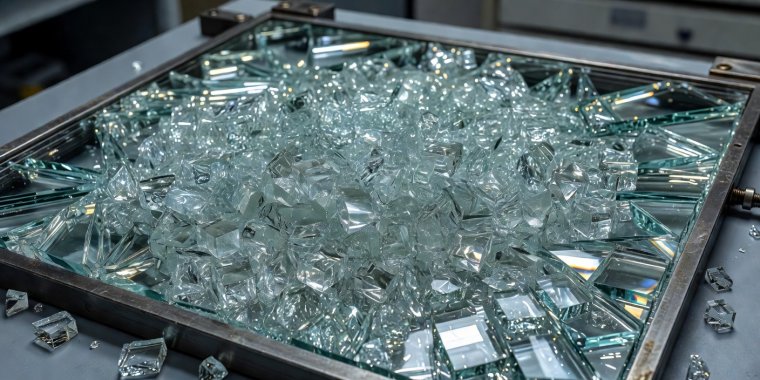
The Thermal Tempering Cycle
To manufacture fully tempered (toughened) glass, annealed glass sheets are cut, polished, and washed before being heated to roughly 650°C—near the softening point of soda-lime silicate glass. Once uniform plastic state is reached, the glass moves swiftly into a quench chamber where arrays of high-pressure air nozzles blast cold air across both surfaces.
The exterior surfaces cool and freeze almost instantly. Meanwhile, the molten core cools more slowly. As the interior contracts, it pulls against the rigid outer skins, creating balanced permanent stresses:
- Outer Surface: High compression stress (minimum 69 to 100 MPa).
- Internal Center: Compensating tensile stress.
Before any applied mechanical or thermal load can cause the glass to crack, it must first overcome that 100 MPa surface compression. This increases its load-bearing capacity by four to five times compared to ordinary annealed glass.
Heat-Strengthened vs Fully Tempered
Building codes distinguish between two thermal treatments:
Fully Tempered Glass
Meets critical safety glazing codes (EN 12150, ANSI Z97.1). Fragments into thousands of tiny, blunt granular pieces upon breakage, reducing serious laceration risks.
Heat-Strengthened Glass
Cooled at a gentler rate. It has roughly double the strength of annealed glass and does not shatter into tiny cubes. It resists thermal shock in spandrel panels and tends to stay within its frame when cracked.
Nickel Sulfide (NiS) Inclusions and Heat Soak Testing
A well-known phenomenon in the glazing industry is the spontaneous explosion of tempered panes without visible impact. The primary cause is microscopic Nickel Sulfide (NiS) inclusions introduced during raw batch float processing.
During the rapid cooling phase of tempering, high-temperature alpha-phase NiS particles freeze before they can transition to their lower-temperature beta-phase. Over several years, exposed to sun and heat, these inclusions slowly revert to the beta-phase, expanding in volume by 2 to 4%. When this expansion occurs in the glass's high-tension central zone, it triggers sudden, spontaneous failure.
To eliminate this risk on high-rise curtain walls and glass roofs, engineers specify Heat Soak Testing (HST) under standard EN 14179. Panes are placed in an industrial thermal chamber at 290°C for several hours, forcing contaminated sheets to fail safely in the factory rather than on the job site.
Mandatory Safety Glazing Locations
Under international building regulations, safety glass (either fully tempered or laminated) is legally required in "critical impact zones":
- Glazing in any door (sliding, hinged, bi-fold, or pivot).
- Fixed glazing adjacent to doors within a 300mm horizontal radius.
- Windows with bottom edges positioned less than 800mm above finished floor level.
- Glass barriers, balustrades, staircase enclosures, and bathroom wet-room screens.